





Have you read Zahid Rafiq?
Updated On: 09 June, 2025 07:21 AM IST | Mumbai | Ajaz Ashraf
The Srinagar native’s short story collection, The World With Its Mouth Open, stirs readers’ conscience while vividly depicting the lives of characters who appear broken in a world unhinged by a bloody past

Listen to this article :
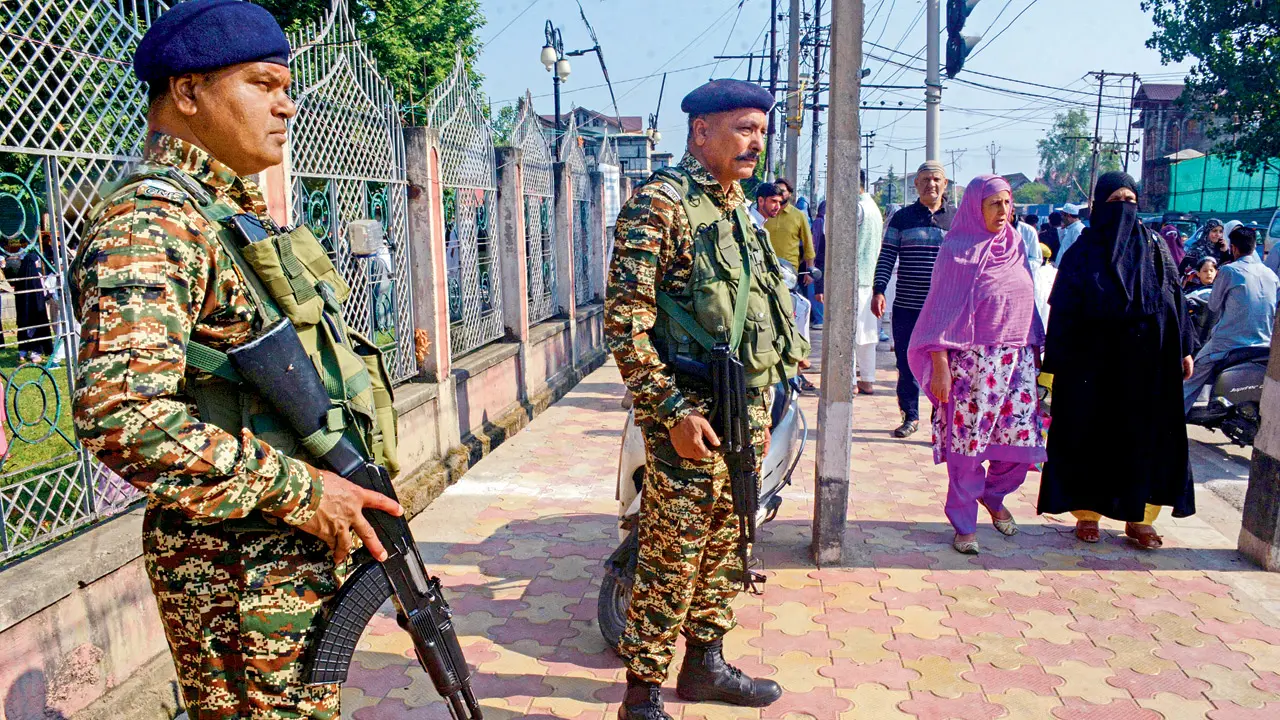
Security personnel stand guard outside Eidgah ground as people arrive to offer prayers at Aali Masjid on the occasion of Eid-ul-Azha, in Srinagar, Jammu and Kashmir on June 7. Pic/PTI
 In Zahid Rafiq’s The World With Its Mouth Open, a collection of 11 short stories, not a single bullet is fired, nor does a person die. Yet the scars of violence, deeper than wounds, can be seen in each of these stories; fear, even terror, looms; and protagonists appear broken in a world unhinged by a bloody past. Seldom has violence been depicted as non-violently, and so chillingly, as Rafiq has in The World.
The 11 stories unfold in a land that is not named. But you know it’s Kashmir because a biographical line on Rafiq says he lives in Srinagar, and because of occasional references to famous landmarks such as Nishat Bagh and Lal Chowk. You know it’s Kashmir also because a gaggle of journalists, in In Small Boxes, gather at tea shops, smoke cheap cigarettes, and discuss literature and politics. The story’s narrator recollects he didn’t know much about either, and neither did most of them, “so we said whatever came to us, as long as we agreed that Kashmir must become free.”
But Kashmir isn’t or doesn’t feel free to the poet-academic who, in Bare Feet, finds that every neighbourhood of the city in which he grew up has “nothing but bunkers made of sandbags with loops of barbed wires wound around, and from little holes in the bunkers, dark eyes watch you with pointed barrels. They are everywhere, the bunkers, the blind eyes, the searching muzzles.”
Trending Stories
Latest Photos
Latest Videos
Latest Web Stories
ADVERTISEMENT
Mid-Day Fast
ADVERTISEMENT

ADVERTISEMENT