





Home / News / World News / Article /
South Africa: Radioactive rhino horns to fight poaching
Updated On: 02 August, 2025 08:50 AM IST | Mokopane (SA) | Agencies
Last year, about 20 rhinos at a sanctuary were injected with isotopes in trials that paved the way for Thursday’s launch. South Africa has the largest population of rhinos, with an estimated 16,000

Listen to this article :
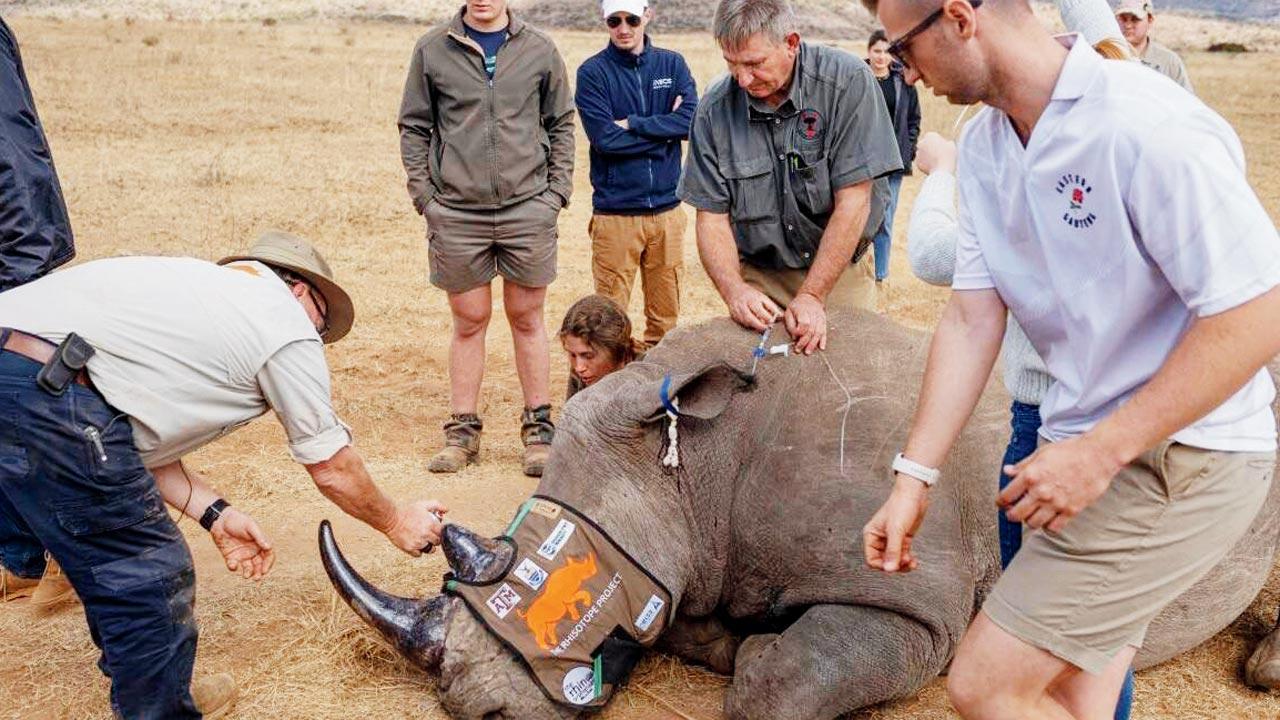
Researchers implant isotopes into the horns of a sedated rhino in Mokopane, South Africa. Pic/AFP
A South African university launched an anti-poaching campaign on Thursday to inject the horns of rhinos with radioactive isotopes that it says are harmless for the animals but can be detected by customs agents.
Under the collaborative project involving the University of the Witwatersrand, nuclear energy officials and conservationists, five rhinos were injected in what the university hopes will be the start of a mass injection of the declining rhino population.
Last year, about 20 rhinos at a sanctuary were injected with isotopes in trials that paved the way for Thursday’s launch. South Africa has the largest population of rhinos, with an estimated 16,000.
Read Next Story
Trending Stories
Latest Photos
Latest Videos
Latest Web Stories
ADVERTISEMENT
Mid-Day Fast
ADVERTISEMENT

ADVERTISEMENT