Myth of Bangladeshis in India
Updated On: 04 August, 2025 07:16 AM IST | Mumbai | Ajaz Ashraf
The population of Bangladeshi Muslims residing here is most likely nowhere near the figure cited by government, as evidenced by the low number of illegal immigrants caught in countrywide police raids



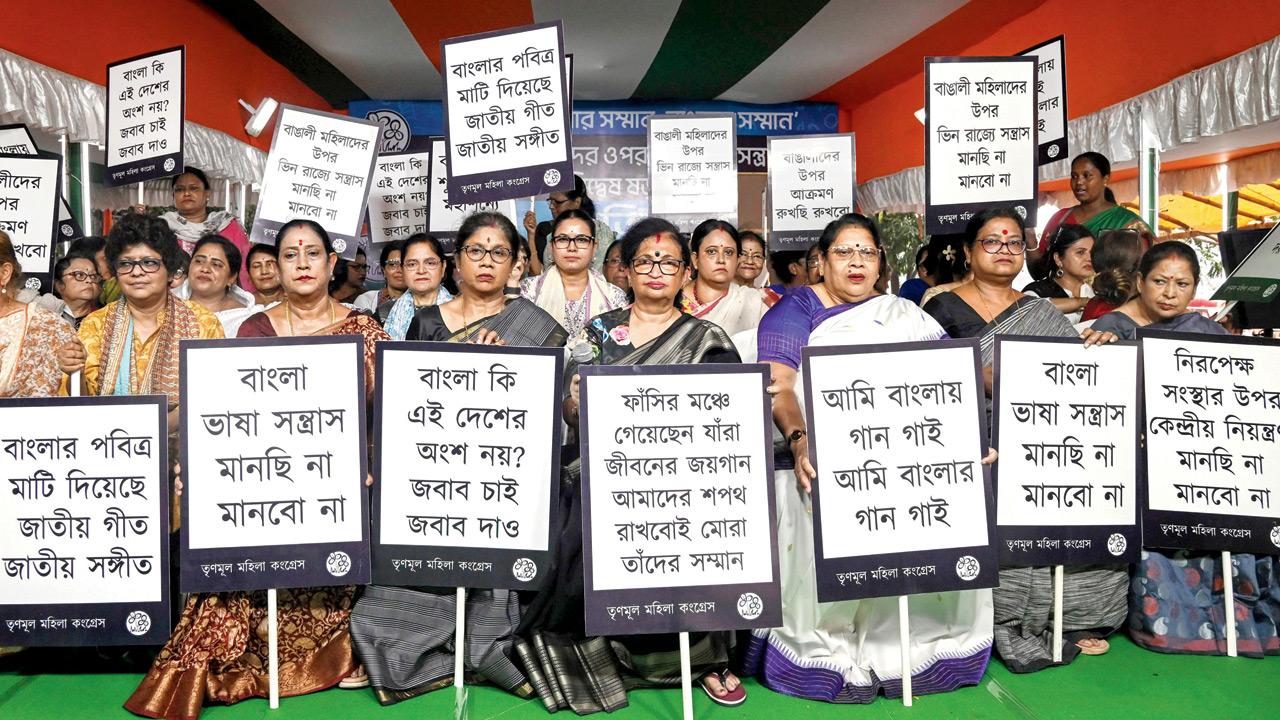
Trinamool Congress leaders stage a protest against the branding of migrants as Bangladeshis, among other things, in Kolkata on Saturday. Pic/PTI
 The hunt for Bangladeshi Muslims staying illegally in India is based on the perception that their population is large enough to pose demographic and security threats to it. This perception, in turn, has been built on the estimates of their population that State functionaries have periodically provided. They were 20 million in 2016, Union Minister Kiren Rijiju said in the Rajya Sabha, apparently having doubled from 10 million in 1997, the year in which then Home Minister Indrajit Gupta divulged this figure to Parliament.
Such claims regarding illegal Bangladeshi immigrants appear grossly exaggerated, a reading of historian Arupjyoti Saikia’s The Quest for Modern Assam: A History (1942-2000) shows. Weaving together diverse sources and data into a compelling narrative, Saikia identifies distinct phases of population “flow” from East Pakistan/Bangladesh into India. The first of these was triggered by the Partition violence, prompting Hindus there to seek refuge in India. They spread across West Bengal, Assam, and Tripura.
With the Hindus also came some Muslims, who had earlier left Assam in anticipation of Pakistan being born, before belatedly realising they would enjoy better land rights in India. These Muslim returnees could have only marginally offset the lakhs of their community members who went over from India to Pakistan.
Trending Stories
Latest Photos
Latest Videos
Latest Web Stories
ADVERTISEMENT
Mid-Day Fast
ADVERTISEMENT

ADVERTISEMENT