Heart beats for Dhadak-2
Updated On: 10 August, 2025 09:25 AM IST | Mumbai | Meenakshi Shedde
Shazia Iqbal’s Dhadak 2 is a heroic achievement: a Muslim woman director directing a strong mainstream Bollywood film on caste issues, with stars, and backed by Karan Johar’s Dharma Productions and getting an all-India theatrical release. Waah! A must-see film.



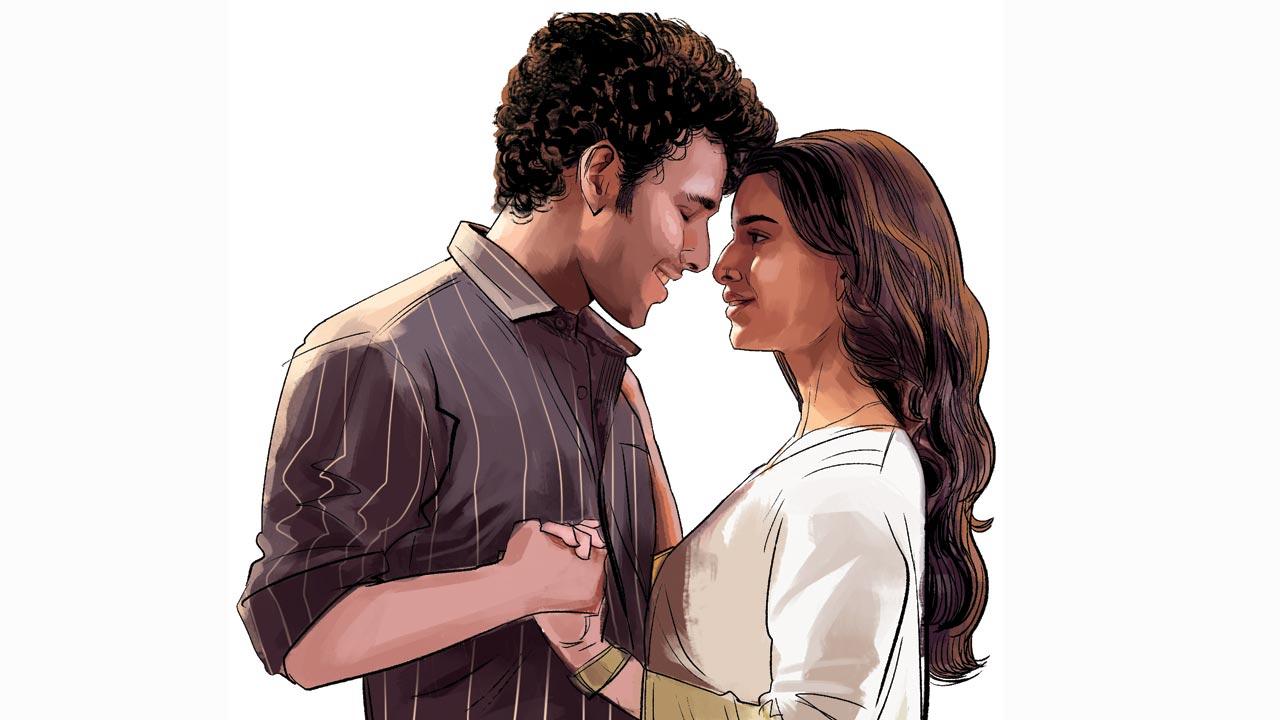
Illustration/Uday Mohite
 Shazia Iqbal’s debut feature Dhadak-2 is an important Bollywood mainstream film that passionately and thoughtfully discusses caste and patriarchy. This is already a heroic achievement. Iqbal is not your good Muslim girl template: Raised in Bihar, she wanted to be an astronaut, trained as an architect, has been production designer for over a decade, including on Sacred Games. She earlier directed the explosively good short Bebaak, on a Muslim girl asked to “become conservative” in order to qualify for a minority scholarship for her studies, and an episode in the mini-series Love Storiyaan, based on the daring, real-life India Love Project stories, both questioning received wisdom in religion and tradition; Dhadak 2, now in theatres nationwide, carries the torch forward.
Dhadak 2, while not a perfect film, is a must-see for many reasons. First, Karan Johar’s Dharma Productions, that produced Dhadak, the damp squib (remake of Nagraj Manjule’s Sairat), still backed Dhadak 2, adaptation of Mari Selvaraj’s brilliant Pariyerum Perumal in Tamil. Then to produce a debut feature by a Muslim woman director on caste issues in mainstream Bollywood is nothing short of tremendous courage by Johar, given Bollywood’s largely regressive, misogynic ethos, with negligible women directors and general revulsion for addressing social realities like caste. He has, of course, also produced Neeraj Ghaywan’s Homebound, a magnificent, heartbreaking film on caste and class, also with mainstream stars Ishan Khatter, Janhvi Kapoor and Vishal Jethwa, that was at Cannes and now selected at the Toronto International Film Festival as well. Both are admirable, I call “mindie” films —mainstream films on realistic, ‘indie issues’, but with stars, songs and action—following the model of Pa Ranjith, Nagraj Manjule, Mari Selvaraj and others. And a woman director has got a Bollywood all-India theatrical release in 2025 — brava! Salute, Karan Johar!
The story broadly follows Pariyerum Perumal (PP), with significant changes: Neelesh (Siddhant Chaturvedi), a Dalit student gets into law college on a reservation quota; upper caste student Vidhi (Tripti Dimri) falls in love with him. From someone hiding his identity, Neelesh become more assertive of his identity — but Vidhi is the big change; no longer merely the sweet innocent girl of PP, who is clueless how her own family has beaten up Pari at a family wedding. Spoiler alert here—Vidhi registers a fierce, vocal protest against her family practising violent caste attacks and holding her accountable for the family honour, instead of holding her violent, casteist cousin Ronnie accountable for the family’s honour for nearly killing a man simply for being “low” caste. Spoiler ends. As Neelesh comments in the film, practising caste is a refusal to acknowledge another as human. Scriptwriters Rahul Badwelkar and Shazia Iqbal also introduce Shekhar, a Rohith Vemula-like character who protests campus injustice, and through whom Neelesh understands that not being political is not an option. The masterly climax of PP is burned in my heart – the two glasses of tea, one black, the other with milk, with a mallipoo, jasmine flower, between them, standing in for the girl, with the aching Vaa rayil vida polaama song. Yet, Iqbal understands that caste and patriarchy are closely linked, and strongly protests against the status quo. She also has a killer on the loose getting rid of low caste people who get above their station, pointing to the systemic murderers we all are, who support/are complicitly silent on caste oppression and violence.
Trending Stories
Latest Photos
Latest Videos
Latest Web Stories
ADVERTISEMENT
Mid-Day Fast
ADVERTISEMENT

ADVERTISEMENT