





Home / Mumbai-guide / Things To Do / Article /
Two families with young children share how they combated the virus, plus expert
Updated On: 19 May, 2021 11:22 AM IST | Mumbai | Anindita Paul
Unlike the first wave, Covid-19’s second surge in India has taken children by surprise, leaving parents fumbling. Two families that survived the treatment-isolation challenge, discuss their learnings

Listen to this article :
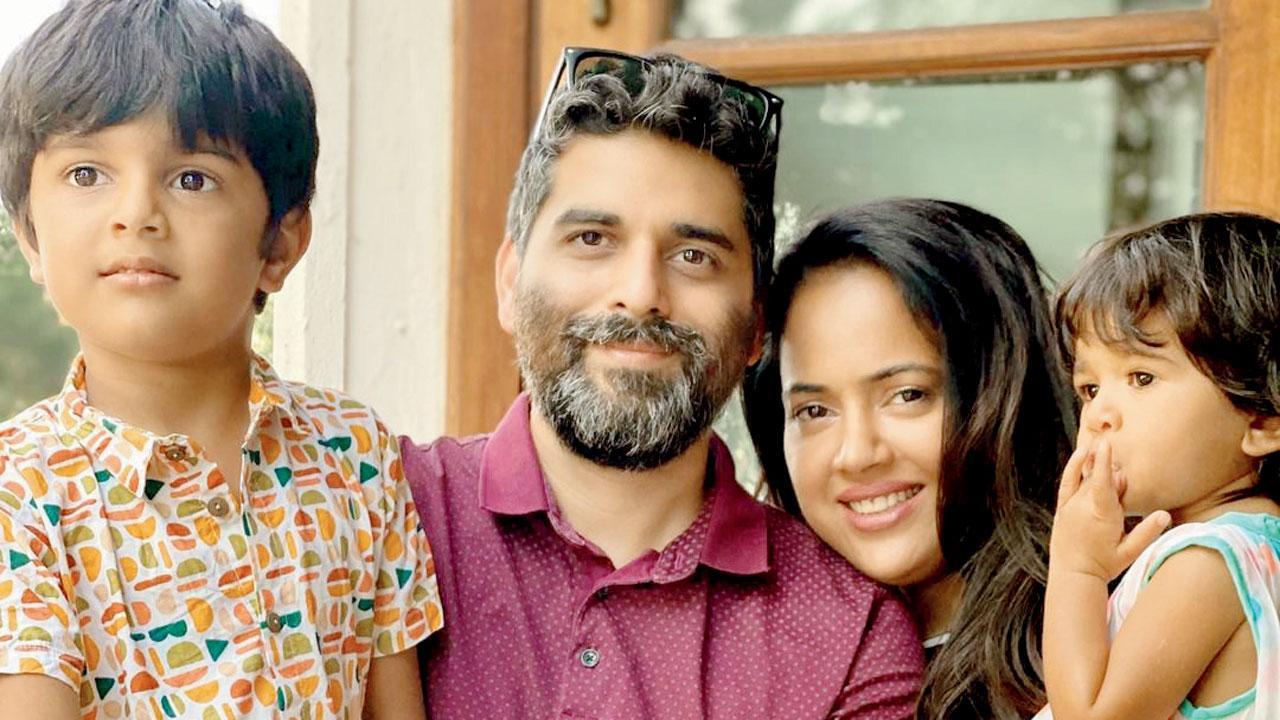
Sameera Reddy and her kids recently tested positive. Pic/Instagram
Recently, former actor Sameera Reddy shared on social media that she and her husband, along with her daughter Nyra and son Hans, tested positive for Coronavirus. Her children, aged one and six years respectively, are among the more than 79,000 kids in the country who have tested positive since March, this year, as per data from the Union health ministry. Evidence also suggests that more children are symptomatic than in the first wave and the severity of the illness in the paediatric age group has increased. Young mothers, whose children recently braved a positive diagnosis, share their experience and insights.
Watch out for atypical symptoms
One morning, my 12-year-old daughter Parissa woke up with extreme pain in her legs. At first, we thought she had pulled a hamstring and that it would get better with rest. But, that evening, when I got home from work, she had a fever of over 99 degrees F. We quarantined her as a precautionary measure. That night, while she was asleep in her bedroom, the pain swept across her body and she couldn’t turn on her sides or lift her legs and arms. Her fever was around 100 degrees F. We immediately arranged for a Covid-19 test and continued to quarantine her. Her condition began to deteriorate and the pain became unbearable to the point where she was barely able to walk. After her test indicated that she was positive for the virus, I quarantined with her so that I could care for her. By then, she had begun vomiting and couldn’t eat. We consulted a paediatrician. Her body had swollen up and she was throwing up everything she ate, including medicines. The pain had intensified and she started developing rashes. Her oxygen levels remained normal throughout this period. When I spoke with a friend, who is a doctor, she advised me to hospitalise Parissa. We admitted her in a children’s hospital, where she was administered steroids. The doctors there identified it as a case of Multisystem Inflammatory Syndrome in Children (MIS-C). She was put on Intravenous Immune Globulin (IVIG) therapy and, after two days, her condition improved slightly. We were at the hospital for seven days after which, we brought her home and continued her steroid medication for seven days.
Read Next Story
Trending Stories
Latest Photos
Latest Videos
Latest Web Stories
ADVERTISEMENT
Mid-Day Fast
ADVERTISEMENT

ADVERTISEMENT